
Scott County Court Record Requests
Scott County’s copy-request information lays out three routes: remote search, courthouse access, and Court Administration. MCRO gives the public free remote documents. For the deepest public electronic access, use the Scott County Law Library’s MPA courthouse view. Court Administration takes care of paper material. It also handles certified and exemplified copies, off-site files, and anything MCRO cannot reach.
You can reach the office at the counter, by phone, mail, or fax. The official email control and eligible eFiling work too. Mail goes to Scott County Court Administration, 200 Fourth Avenue West, Shakopee, MN 55379. The phone number is (952) 496-8200; fax is (952) 496-8211. One caution: eFS files and serves documents. It is not a Scott County public search database. A non-party filing through eFiling should ask Court Administration for an administrative file number.
- Find the Scott County case number and public Scott County case details through MCRO or at the Scott County Law Library terminal.
- Name the Scott County document, event, date, or document index number and choose plain, certified, or exemplified service.
- Send the form or clear request through the appropriate Scott County channel, including the counter, mail, fax, email control, or eligible eFiling route.
- Use the delivery and payment instructions given by Scott County Court Administration, then allow more time for Scott County off-site material.
Be specific about what you want. Scott County court staff cannot choose which record or copy type fits your request, so name the document and the copy type yourself.
Scott County Record Access Channels
Scott County MCRO offers Case, Document, Hearing, and Judgment Search. It is free from anywhere, though date, case-type, and access limits apply. The Law Library terminal beats it for depth. At the counter, staff handle local public records. They also handle certification and case-copy procedures. Phone works for routing a Scott County case question. No one there can give legal advice.
Mail works with a clear letter or the statewide copy form plus payment. Fax and email cover only permitted plain, nonconfidential Scott County copies. Pay by check or money order as Court Administration directs; never mail cash. A federal court file calls for PACER, not a Scott County court-record request.
One more note: a city police or city-code request is not a Scott County District Court record request. That holds even if a city agency started the underlying matter.
Kinds of Court Records
Scott County District Court holds original jurisdiction over civil, family, probate, juvenile, criminal, and traffic matters filed in the county. Its public records can include the Register of Actions. They may also hold public case information, hearing entries, orders, judgments, and filed documents the court releases. What you can see depends on three things. The case category matters, the document classification matters, and so does whether you search remotely or show up at the courthouse.
- Scott County case information and the Register of Actions, which is the chronological record of activities and filings.
- Scott County public case events, hearing information, dispositions, and related case references.
- Scott County orders, notices, opinions, and public documents available through MCRO or courthouse access.
- Scott County judgment details and satisfactions when shown in the public case system.
- Scott County criminal, civil, family, probate, juvenile, and traffic records subject to their governing access rules.
A Scott County calendar is not the full case file. And a free remote document is never a certified Scott County court record.
Scott County Downloads and Courthouse View
Downloads through Scott County MCRO cost nothing when a document is remotely accessible. The remote layer will not issue certified copies. It also will not issue certified judgments or a stand-in for paper and off-site files. The Law Library’s MPA courthouse view exists for the fullest public electronic access to statewide district-court records. It is a public terminal, not a web form.
Remote access runs broader for many qualifying criminal and civil records filed on or after July 1, 2015. Family and paternity categories are different, often with limits on registers, calendars, and court-generated documents. An attachment may be missing from MCRO. The courthouse may still let you view it. In the end, the court’s own classification controls the result.
Court Records: What They Contain
A Scott County case record organizes public information around the file. What displays can shift with case type. Access rules play a part too. Sometimes a Register of Actions entry is visible while its attachment stays unavailable remotely. That is where a Scott County document index number helps. It identifies the event or filing when you make a copy request.
| Case number | The unique Scott County MNCIS file identifier, such as 70-CR-26-01234 when that is the number displayed by the court. |
|---|---|
| Case information | Scott County public title, type, filing date, venue, judicial officer, status, flags, and related cases when available. |
| Parties and attorneys | Scott County public role labels and attorney information, without every private contact field. |
| Case events | Chronological Scott County activities, proceedings, and filings, often with event or document names and index numbers. |
| Hearings and dispositions | Scheduled or past Scott County public hearing entries and recorded outcomes when available. |
| Financial and judgment data | Scott County public fines, fees, payments, judgments, or satisfactions when the system displays them. |
A charge is only an allegation, never a conviction. And a judgment entry does not by itself prove payment or satisfaction.
Scott County Copy Form Fields
Scott County’s statewide Copy Request Form asks for plenty: contact information, county, case type, court file number, parties, the document you want, its date or index number, copy type, number of copies, delivery method, and payment. Four document rows fit on the form, and added pages are allowed. If a criminal defendant’s date of birth is available, the form requests it. Skip putting it in an unnecessary public email.
Describe the document so it matches the Scott County public case event. No file number? Give every identifying detail you can, including Scott County. Then name the delivery choice: mail, pickup, plain nonconfidential fax or email. Another prepaid method the court allows works too. Staff cannot pick the document for you.
Copy Fees and Certification
Downloading from MCRO costs nothing when the record is open there. Certified and exemplified copies are different. Those come from Scott County Court Administration. Pricing follows the current District Court Fees table. Fees change. Compare the amounts below against the live table before you send a request.
The law library may add its own charges. Scanning and fax work runs $25 per 50 pages or part. Fee waivers or reductions exist for people who qualify. Before ordering a thick file, a paper record needing staff time, or something pulled from storage, ask for the current total.
| Scott County copy item | Amount |
|---|---|
| Uncertified instrument, printout, scan, picture, or screen print | $0 |
| Certified copy or certified courthouse MNCIS printout | $14 |
| Exemplified plus uncertified instrument | $14 |
| Exemplified plus certified instrument | $28 |
| Certified judgment search | $5 per name |
| Case-system report by email or paper | $5 for 1–50 pages; $25 per additional 50 pages or part |
Scott County Certified and Exemplified Copies
Pick your copy type with care. A certified copy of a Scott County court record comes with the court's authentication. It may also carry a raised seal. An exemplified copy goes further. It adds the signatures of a judicial officer and a court administrator. There is also a combined option that carries both forms of backing. It costs more. Ask the receiving agency what it actually requires before you pay for the upgrade.
One limit matters here. Scott County can certify only District Court records filed in Scott County, and MCRO cannot issue certifications at all. Certified documents that run multiple pages arrive stapled, and pulling that staple out can void the certification. A saved image of a docket entry may help you spot the right event, but it is not a certified court record.
Access Rules for Court Records
Who gets to see what in Minnesota comes from the Rules of Public Access to Records of the Judicial Branch. Rule 8 lets the public inspect and copy original court records where the court keeps them. That covers regular hours. The rule also draws a line between courthouse access and remote access. Some material stays closed. Rule 4 lists the records and categories the public cannot reach. Minnesota Statutes chapter 13 sets the general framework for government data. But the judiciary's own court-record rules control here. That statute does not override them.
Key access rules
Rule 8 explains public inspection, copies, the Register of Actions, and the distinction between remote and courthouse access.
Rule 4 identifies protected record categories and does not promise release merely because a request is made.
Minnesota Statutes section 357.021 supports the court’s filing and copy-fee structure.
Scott County Restricted Record Orders
Court records in Scott County sit behind more than one kind of wall. A case can be confidential by rule or statute. It can be sealed by court order. Or it can sit open at the courthouse yet stay limited for remote viewing. Juvenile, adoption, commitment, domestic-abuse, harassment, protected-identifier, medical, sealed, and expunged files can all call for special handling. So treat a remote docket result with caution. It may not show everything. An attachment that seems missing may well have been filed.
Scott Court Administration states the rule plainly. Confidential documents cannot be copied without a signed judge's order granting access. A named party in a confidential but unsealed case may still get records once identity is verified. Anyone outside the case, or anyone chasing a sealed file, generally needs a judge to review the request first. Adoption records follow a separate procedure of their own.
Minnesota offers an official page for Minnesota confidential-information forms. It lays out the paperwork used to request this kind of access in a Scott County court records search.
Forms do not reclassify records. They only help route an access question to the right place.
Scott County CON101 Access Requests
CON101 is not a magic key. It asks a judicial officer to review access to a confidential or sealed record after ordinary Court Administration access has failed, or when the rule requires review. You will need the county and district, the file number if known, the case type, the case name or a party, your own interest, the exact records sought, and a detailed reason. It is not a general request to make any record public.
Filing is simple enough. The CON100 instructions allow filing in person, by mail, or electronically through eFS. The access request carries no filing fee. If the judicial officer grants access, you then submit a copy request with the signed order attached. One caution: do not use CON101 for adoption records.
Scott County Older and Off-Site Files
Old Scott County files sometimes sit off-site. That slows things down. Most requests made in person at the courthouse get handled the same day, but the official guidance warns that retrieving off-site material can push a request past that mark. When you contact Court Administration, ask three things: whether the court record exists on site, whether staff must retrieve it, and whether your description of the document or case event needs to be more specific.
A schedule governs how long records last. The District Court Record Retention schedule sets minimum periods. It also allows courts to transfer or destroy material once it is no longer required. It does not give anyone a right to destruction, though. And it cannot prove that an old remote record was never filed just because it is missing now.
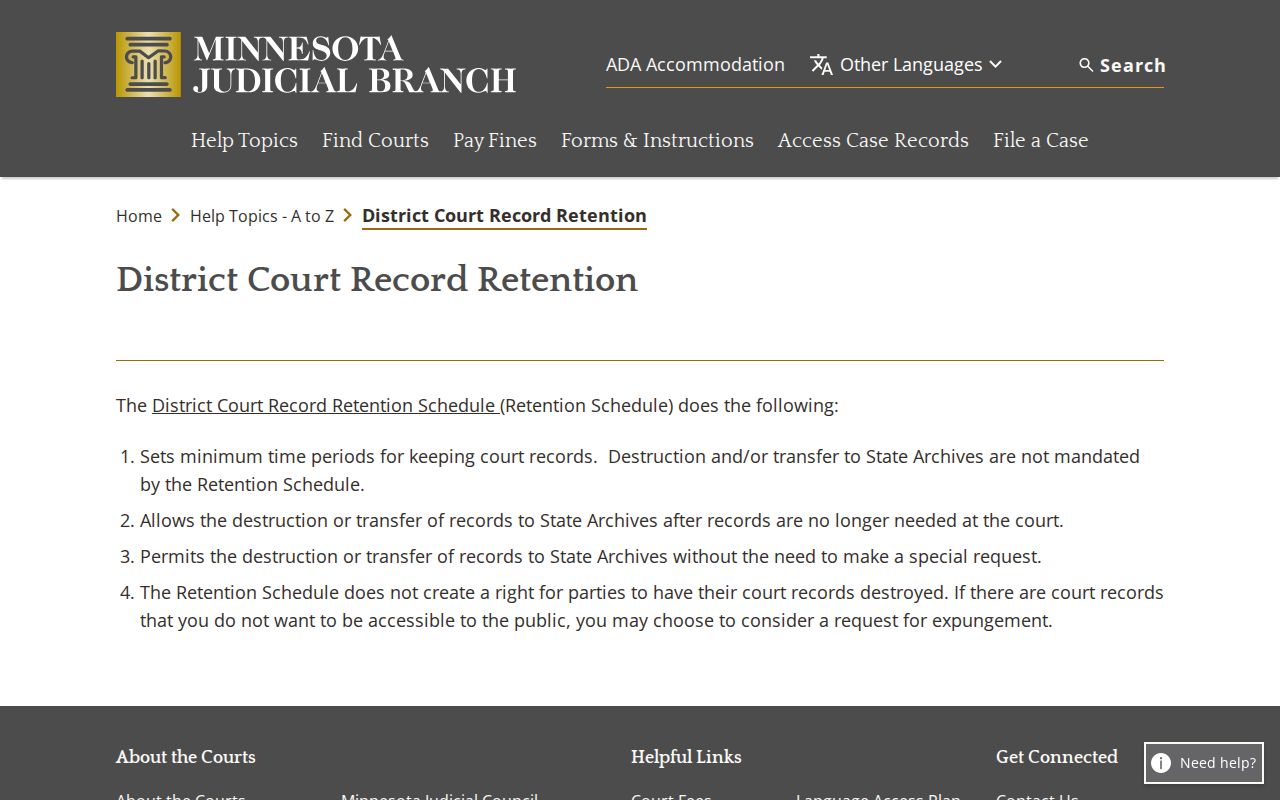
Retention rules give useful context for an older Scott County court-record request, but only Court Administration can say whether the record itself is still available.
Scott County Court Administration
Need a certified copy, an off-site record, or a case number question answered? Court Administration is the local route. Staff can copy and certify Scott County District Court records. They cannot pull files from another county, a different court level, a city administrative office, or a federal docket. The same goes for a document MCRO does not show. For email, use the official contact control on the court's page. That is safer than sending sensitive details through an unverified message.
Scott County Court Administration
Scott County Justice Center
200 Fourth Avenue West, Government Center - JC115
Shakopee, MN 55379-1220
(952) 496-8200
Bring the full case number and photo identification whenever the court requires proof of identity. The clerk can route a public-record request but cannot offer legal advice.