
Scott County Civil Docket Searches
Minnesota Court Records Online, or MCRO, is the remote Case Search most people use for Scott County civil court dockets. The public form lets you search several ways. Try a full case number, a name, an attorney, or a citation, depending on which fields it offers that day. Treat the results list as a first step only. Click into the matching case and work through the Case Details screen. There the Register of Actions, party roles, events, hearing history, and any permitted document links tell the real story of the docket.
Always search with the complete number when you have it. Minnesota case types mark the category. The code CV signals a civil case, but the full MNCIS number pins down one Scott County record far better. One caution: a civil docket can list a public event. The attached filing may still stay closed to remote viewing. For a certified copy, or for an older paper record, go to Court Administration rather than relying on a free MCRO download.
- Open Scott County MCRO Case Search and accept the Scott County public-access terms.
- Search the complete Scott County civil case number, or use a party or attorney name with narrow filters.
- Confirm the Scott County court location, case type, filing date, parties, and status before opening details.
- Read the Scott County Register of Actions with the separate hearing, order, motion, and judgment fields.
- Request a plain or certified copy from Scott County Court Administration when the remote record is not enough.
Scott County Civil Result Limits
A broad Scott County MCRO search can hide useful context. The official Scott County search guidance caps results at 200. A long list may simply be cut off. Narrow the civil docket search instead of trusting a general name sweep. Filter by county, filing date, status, category, or a complete case number to catch everything public. Spelling comes first. After that, middle-name variations, a wildcard after two characters, or Sounds Like can all help. Note that wildcard and Sounds Like cannot combine in one query.
| Filter | Use in a Scott civil search |
|---|---|
| County | Choose Scott County after checking that the case was filed in Scott County. |
| Case category | Use the Scott County civil category to reduce unrelated case types. |
| Status and date | Limit a large Scott County result set to the period or posture being checked. |
| Full case number | Use this when available for the most direct Scott County route to the correct record. |
What if the Scott County search returns nothing? Try the Scott County courthouse Law Library's Minnesota Public Access view, or ask Scott County Court Administration where a specific civil case routes. An empty remote result settles neither access nor retention.
Civil Dockets: What They Show
Think of a Scott County civil docket as the court's Register of Actions. It is a running list of case activity in order. The overview screen may show the case number, filing date, venue, judicial officer, status, and related cases. Party Information names public roles such as plaintiff, petitioner, defendant, or respondent. Attorneys are sometimes listed too. Case Events track filings, service, motions, orders, and hearings. A document link may sit beside an event. Even without one, an index-only entry still records that the activity happened.
| Case number | The unique Scott County MNCIS identifier. A CV type code identifies a civil category within the complete number. |
|---|---|
| Parties and attorneys | Scott County public role labels and legal representatives, subject to the access rules. |
| Filings and service | Scott County events such as a complaint, answer, service return, or notice that mark procedural activity. |
| Motions and orders | Scott County requests made to the court and the public order or ruling entries that may follow. |
| Judgment details | Scott County public monetary-judgment, disposition, satisfaction, or related financial information when displayed. |
One caution: the Register of Actions is not the whole file. It logs the public activity of a Scott County case in sequence, nothing more. Whether a document downloads is a separate question, governed by date, case type, and the Minnesota Rules of Public Access.
Scott County Civil Entries in Context
Docket language records steps, not verdicts on the parties. In Scott County, a complaint filed means a pleading hit the file. A motion granted means the court ruled on that one motion. It does not mean the whole case closed. A judgment entered means the court recorded it, not that anyone paid or satisfied it. For money judgments, the MCRO Judgment Search layer covers docketed monetary judgments only. It leaves out other civil remedies.
- Service
- A docketed event showing procedural delivery or an attempt to deliver a court paper.
- Scheduling conference
- A court setting used to organize later steps; it is not a decision on the merits.
- Judgment
- An entered monetary or adjudicative determination recorded in the case.
- Satisfaction
- An entry showing that a judgment has been satisfied or released.
These distinctions matter when you follow a civil docket over time. Check the date, the event description, any order, and the entries that come after. Only then read the case's current posture.
What Cases Fill the Civil Docket
Scott County District Court holds original jurisdiction over civil, family, probate, juvenile, criminal, and traffic matters. The civil docket may hold ordinary civil actions and conciliation matters. Other categories the statewide system classifies apart may appear too. Family and probate records follow their own public-access rules. So read each search result by category. Do not assume every court file carries the same remote document coverage.
- Scott County ordinary civil cases involving claims, property, or other civil disputes.
- Scott County Conciliation Court matters using Minnesota's simplified civil process.
- Scott County public motion, service, order, dismissal, settlement, and judgment entries in civil cases.
- Scott County scheduling conferences, court trials, and other civil hearing settings.
- Scott County eviction hearing entries when the official calendar lists that civil setting.
City offices keep administrative or agency records. Those are not a Scott County civil court docket unless a District Court case was actually filed. Conciliation Court, too, is a Minnesota court process rather than a standalone city docket.
Scott County Conciliation Hearings
The official Scott County daily calendar may list Conciliation Hearing as a hearing type. That label marks a setting on the Scott County calendar. It means nothing else. It says nothing about the merits, who will show up, or how things end. The next day's PDF posts at 7:00 p.m. It then updates hourly from 7:00 a.m. during business hours. Still, printed courtroom calendars and lobby monitors at the Scott County courthouse stay the most current reference.
Conciliation setting: Confirm the case number, hearing time, courtroom or connection type, and current courthouse display before relying on an advance calendar entry.
For any civil hearing, pair MCRO Hearing Search with the Scott daily calendar. If the two disagree, call Scott County Court Administration. Never assume one entry controls the schedule.
Hearings on the Civil Docket
A civil docket entry in Scott County can be many things. Scheduling conferences, motions, evictions, conciliation, commitment hearings, court trials, and jury trials all appear as event types. Some settings happen in a Scott County courtroom. Others sit at the Scott County Law Enforcement Center, and many run remotely. The statewide hearing framework took effect February 3, 2025. It explains why entries mix in-person and remote formats. Still, a connection label is no guarantee; the assigned judge can change the setting.
Dates pile up in one civil record, and each one means something different. The filing date opens the case. An event date tracks docket activity. The hearing date marks a scheduled appearance, and a disposition date records an entered result. Document-added dates can reflect document-management timing rather than court action. Match the date field to the question you are actually asking. Otherwise you will read the wrong line. One date never answers for another.
Note: A Scott County calendar row is only a scheduling record. It does not prove the hearing occurred. A continuance is not shown, and neither is a resolution of the Scott County civil case.
Scott County Civil Copy Routes
Need a certified Scott County civil order, or a copy MCRO does not provide? Go through Scott County Court Administration. The public routes are the courthouse counter, phone at (952) 496-8200, mail to 200 Fourth Avenue West, Shakopee, MN 55379, and fax to (952) 496-8211 where permitted. The county's contact-by-email control handles suitable nonconfidential requests. eFS covers eligible copy-request filings. A non-party using eFS should ask Court Administration for an administrative file number first. Before ordering any copy, check the courthouse Law Library's MPA view, the stronger electronic option.
Fees change, so rely on the current table. The Minnesota District Court Fees page lists the costs. The copy and certification costs there apply to Scott County requests.
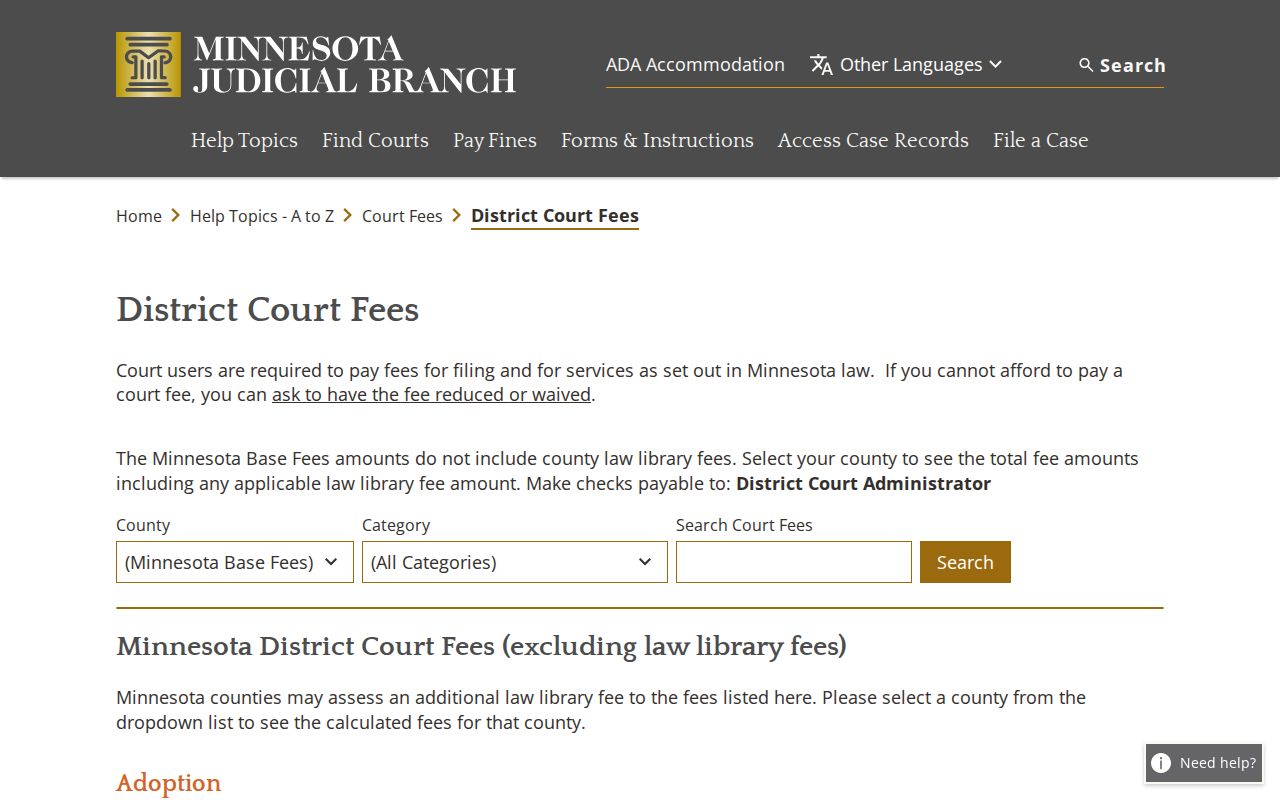
MCRO downloads are free when available remotely. They are not certified copies, though. For a certified copy, exemplified copy, report, scan, fax, or certified judgment search, the current fee table controls, never an old amount you remember.
Make the request clear. Include the county, case type, court file number, parties or roles, document description, date or index number, copy type, delivery method, and payment. Most in-person requests finish the same day. Older or off-site material can take longer.
Who Can See Civil Dockets
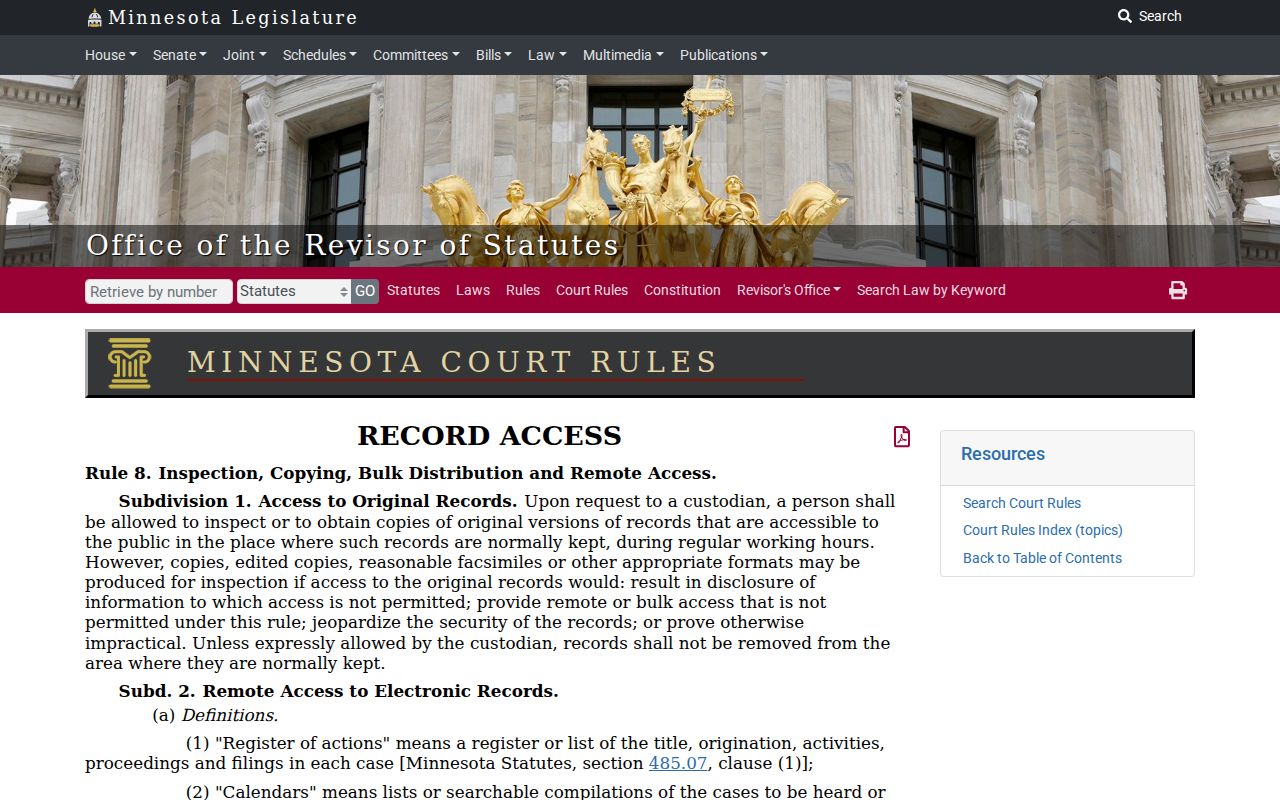
Plenty of Scott County civil Register of Actions entries are public. Courthouse access and remote access are not the same thing, though. Rule 8 lets anyone inspect and copy originals. That access applies where the court normally keeps them, during regular hours. Remote document availability runs narrower for several case types. Family and post-adjudication paternity access often covers less. It reaches only the register, calendars, and court-generated documents. Evidence from a public Scott County proceeding is not automatically viewable from home. The hearing being open is not enough.
The Minnesota Rules of Public Access, Rule 8 sets out the official distinction. Courthouse and remote access are not treated alike there.
Confidential and sealed files follow different rules. Court Administration cannot hand over a confidential document without a judge-signed access order. To seek access to a confidential or sealed civil record, start with forms. File CON101 and CON100 for judicial review. Ordinary email is not a secure substitute for that process.
Key Rules:
Rule 8 defines the Register of Actions and distinguishes local inspection from remote electronic access.
Rule 4 identifies court records and proceedings that are not accessible to the public.
Minnesota Statutes chapter 13 provides general public-data principles, while Judicial Branch records remain controlled by their separate court-access rules.
Scott County Remote Document Gaps
For civil cases filed on or after July 1, 2015, MCRO offers broad public document coverage. Major and minor matters alike are covered. Older filings get thinner court-generated-document coverage. Some records sit open to viewers at the courthouse yet never reach the web. So a Register of Actions entry can be visible while its attachment is not. A missing document link does not mean nothing was filed.
Search MCRO first. Then try the MPA courthouse view. You can also ask Scott County Court Administration whether an older, locally stored, or off-site record can be copied. If the file is confidential or sealed, file the court's access forms and wait for the judge's decision. The District Court Record Retention schedule sets minimum retention periods. It cannot prove that any particular old file still exists.
Minnesota's copy-request options lay out the official page's routes for copies: at the counter, by mail, through eFiling, and by confidential-access request. The accepted payment methods are on the official page too.
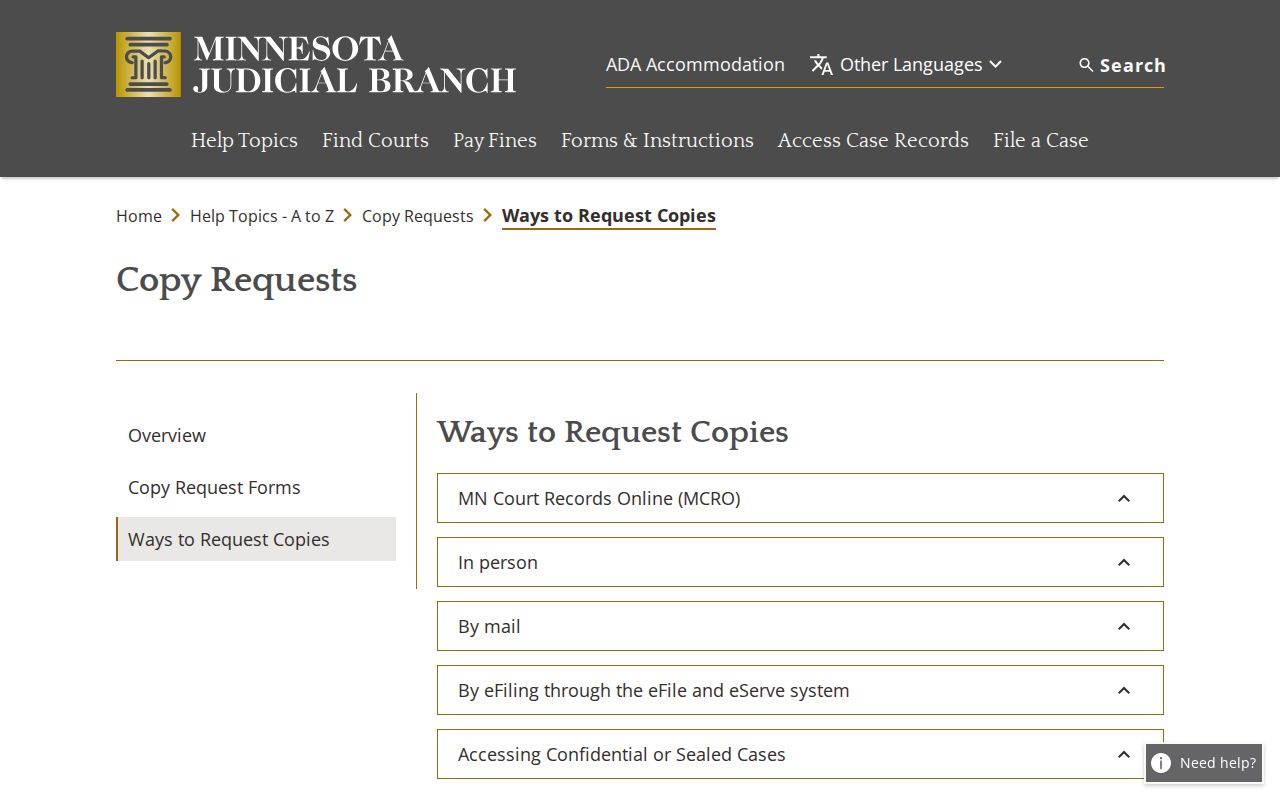
Pick the route that fits the record's access status. A plain, nonconfidential request can follow the standard copy process. A sealed or confidential request needs the court's separate access procedure instead.